




Healthcare cyber security is not an industry buzzword – it’s an aspect crucial to your medical practice’s survival. From HIPAA compliance to patient data security and safeguarding the reputation of your healthcare enterprise, cyber security is a topic that cannot be ignored.
Recent incidents like the ransomware attack on Change Healthcare highlight the urgency of bolstering cyber security defenses in the healthcare sector. According to the Department of Health and Human Services (HHS) Office for Civil Rights, 725 data breaches were reported in 2023, compromising over 133 million records. The true extent of breaches could be even higher, underscoring the critical need for proactive cybersecurity measures.
With hackers emboldened with AI powered software, you might wonder, can such attacks be prevented?
The good news is that implementing cybersecurity tips recommended by leading HIPPA and healthcare cybersecurity experts will go a long way toward safeguarding your medical enterprise.
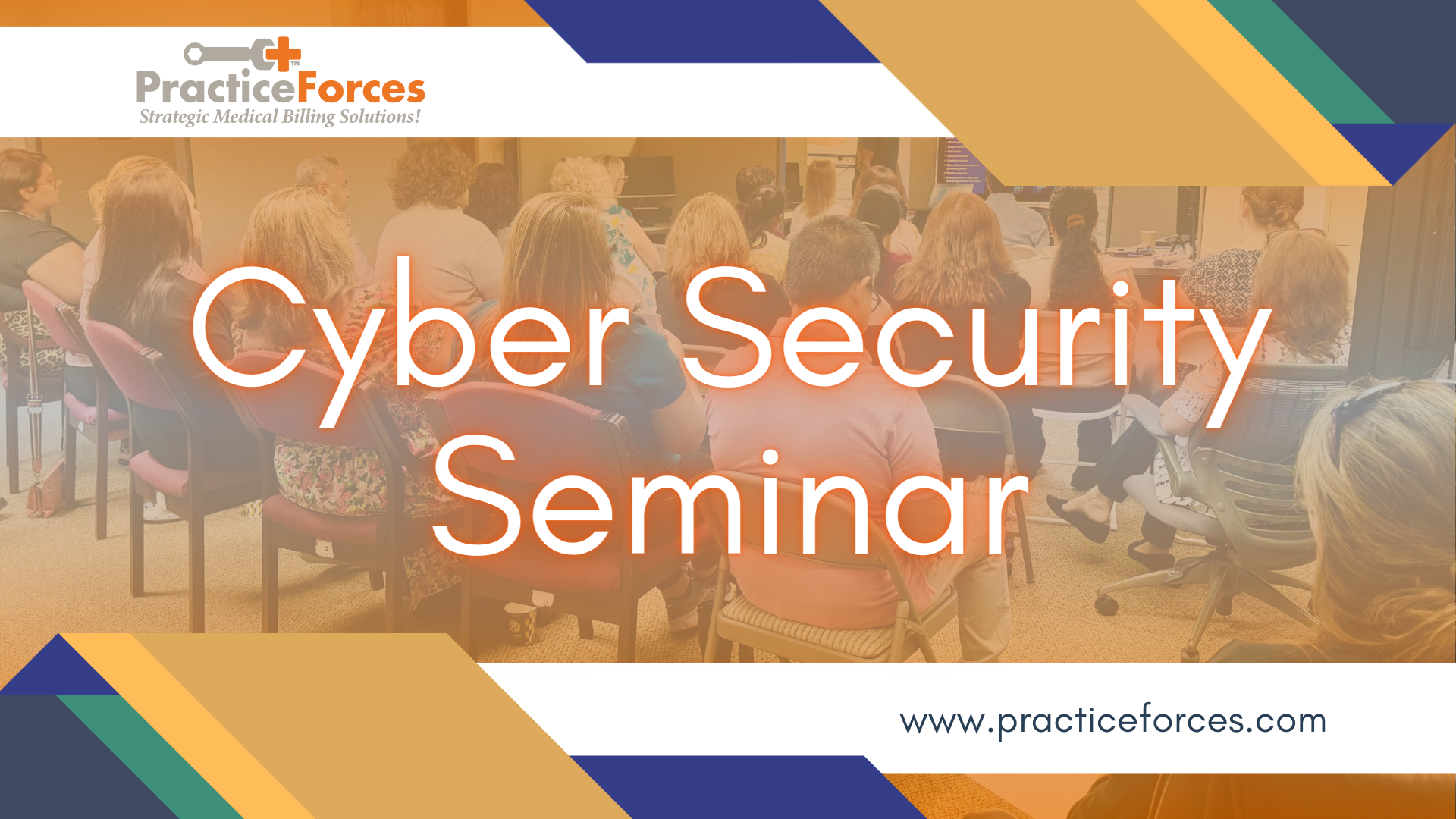
With this agenda in mind, we recently concluded the first PracticeForces Cyber Security seminar at our premises in Clearwater, Florida. The speakers at the event (held on June 06, 2024) were HIPAA specialist Michael D. McCoy from HITECH Compliance Associates and a global cyber security specialist (with several years of field experience in working with government agencies worldwide).
Our speakers shared cyber security tips and tools necessary to fortify healthcare enterprises’ IT infrastructure and safeguard sensitive patient data.
Here are the top healthcare cyber security and patient data security tips shared during the seminar:
1. Beware of malicious email links and attachments – also known as Phishing emails!
Curiosity sometimes gets the better of us! Cyber criminals sometimes use this to lure us into clicking email links or downloading attachments, which can compromise your enterprise’s IT infrastructure. Remind your staff to double-check before clicking any link or attachment contained in an email from an unknown sender. A common ploy is to make it look like you have received an email from a government department, such as the IRS, or a bank warning about your cards/ accounts being suspended.
2. Ensure you create complex passwords of at least 16 characters
A password of 8 digits can be cracked in a matter of seconds. If you want to safeguard patient information, ensure that you and your medical practice staff always keep complex passwords. It’s recommended that all sensitive logins should have a password of at least 16 characters, include upper-case and & lower-case letters, and have two numbers and a symbol.
Here are some more password security measures:
• Sharing passwords is a big no!
• Don’t save passwords in your browser. Use a password manager instead.
• Never give out passwords over the phone.
• Never share passwords.
• Keep different passwords across software and ensure you change passwords at least every six months.
3. Ensure that patient information shared on email is encrypted
Patients have the right to access their patient records. Emails containing any PHI ( protected health information) must be encrypted. From a compliance perspective, when emailing clients directly, ensure that you have informed the recipient of the risk involved, especially if the information is not encrypted.
Bonus Tip: Perform Security Risk Assessments (SRA)
The Health Insurance Portability and Accountability Act (HIPAA) Security Rule mandates that covered entities and their business associates perform a risk assessment of their healthcare organization. This assessment ensures compliance with HIPAA’s administrative, physical, and technical safeguards. Additionally, it helps identify potential risks to the organization’s protected health information (PHI). For more information on the assessment process and its benefits, refer to the official guidance from HealthIT.gov.
After completing the risk assessment, document the results, including all identified threat/vulnerability pairs, likelihood and impact calculations, and overall risk levels. This documentation is vital for ongoing risk management and helps facilitate communication with organizational leadership.
We cannot emphasize enough the need to ensure that these simple but effective healthcare cyber security measures are implemented at your medical practice.
Also, Watch – the Cyber Security Seminar by Industry Experts at the PracticeForces office
Would you like to attend future seminars on healthcare and cyber security at the PracticeForces headquarters? Follow us on social media to stay informed of upcoming events.