





Hospital Revenue Cycle Management With Collection Partners boosts efficiency by automating claims processing, reducing manual errors, and accelerating reimbursement cycles. PracticeForces clients experience a 15-40% revenue increase within 90 days through streamlined workflows and coding accuracy above 98%, improving cash flow without sacrificing patient care.
Key Takeaways
Automated claim scrubbing catches coding errors before submission, reducing first-pass rejection rates below 5%.
Clean claims move through adjudication without manual intervention, accelerating reimbursement timelines and cash collection.
Coding accuracy above 98% creates a compounding effect where cleaner claims generate faster payments and fewer rework cycles.
Streamlined workflows replace fragmented spreadsheets and paper trails, tracking claims and flagging errors in a unified system.
What is hospital revenue cycle management software?
Hospital revenue cycle management software automates and streamlines the administrative and clinical functions tied to claims processing, payment, and revenue generation. DoctorConnect’s data-driven guide for healthcare administrators describes this software as the backbone of clinic financial operations. Without it, hospitals absorb slower reimbursements, higher denial rates, and mounting manual workloads that erode operating margins.
The software coordinates every step from patient registration through final payment posting. It replaces fragmented spreadsheets and paper trails with a unified workflow that tracks claims, flags errors, and accelerates cash collection. For hospital CFOs and revenue cycle directors, the stakes are direct: delayed claims mean delayed payroll, capital projects, and service expansion.
What core functions does hospital revenue cycle management software handle?
The software manages several connected functions:
Claims submission and tracking
Payment posting and reconciliation
Denial management and appeals
Patient eligibility verification
Coding and charge capture
Financial reporting and analytics
Each function feeds the next. A coding error caught before submission prevents a denial that would otherwise sit in accounts receivable for weeks.
How does hospital revenue cycle management software integrate with existing systems?
Effective solutions go beyond standalone billing. DoctorConnect’s guide notes that strong RCM platforms must integrate with electronic health records, practice management systems, patient engagement tools, and payer networks. Integration minimizes duplicate data entry and keeps clinical and financial records aligned.
PracticeForces takes a different approach to this integration challenge. Rather than bundling proprietary software, the company works within a practice’s existing infrastructure and provides targeted upgrades only when beneficial. That flexibility matters for hospitals with entrenched EHR investments and limited appetite for system replacement.

How does automation improve revenue cycle efficiency?
Automation transforms hospital revenue cycle management by replacing error-prone manual tasks with intelligent, rules-driven workflows. Hospital Revenue Cycle Management Software reduces claim rejections, accelerates reimbursement timelines, and strengthens the patient financial experience. Without these automated safeguards, health systems bleed revenue through preventable denials and delayed payments that compound across thousands of encounters each month.
What repetitive tasks does revenue cycle automation eliminate?
Manual data entry, eligibility verification, and claim status checks consume hours of staff time. Automation replaces these repetitive manual tasks with intelligent workflows across scheduling, registration, claims submission, and payment posting. The result is fewer keystroke errors and consistent processing speed that human teams cannot match during peak volume periods.
How does automation reduce claim denial rates?
Automated claim scrubbing catches coding errors and missing information before submission. PracticeForces achieves first-pass rejection rates of less than 5% through automated workflows that validate claims against payer-specific rules. The company also maintains 12 to 24 hour claim submission cycles, ensuring charges reach payers while reimbursement windows remain open. Each delayed or rejected claim represents revenue that becomes progressively harder to collect as time passes.
Error reduction: Automated validation flags mismatched codes and incomplete fields instantly
Faster reimbursement: Clean claims move through adjudication without manual intervention
Patient experience: Accurate upfront estimates and streamlined billing reduce confusion and complaints
Revenue cycle automation is a strategic advantage that helps hospitals, clinics, and health systems reduce errors, accelerate reimbursement, and improve the patient financial experience. Organizations that delay adoption carry the cost as unrecovered accounts receivable and mounting denial backlogs. PracticeForces couples this automation with coding accuracy above 98%, creating a compounding effect where cleaner claims generate faster payments and fewer rework cycles.
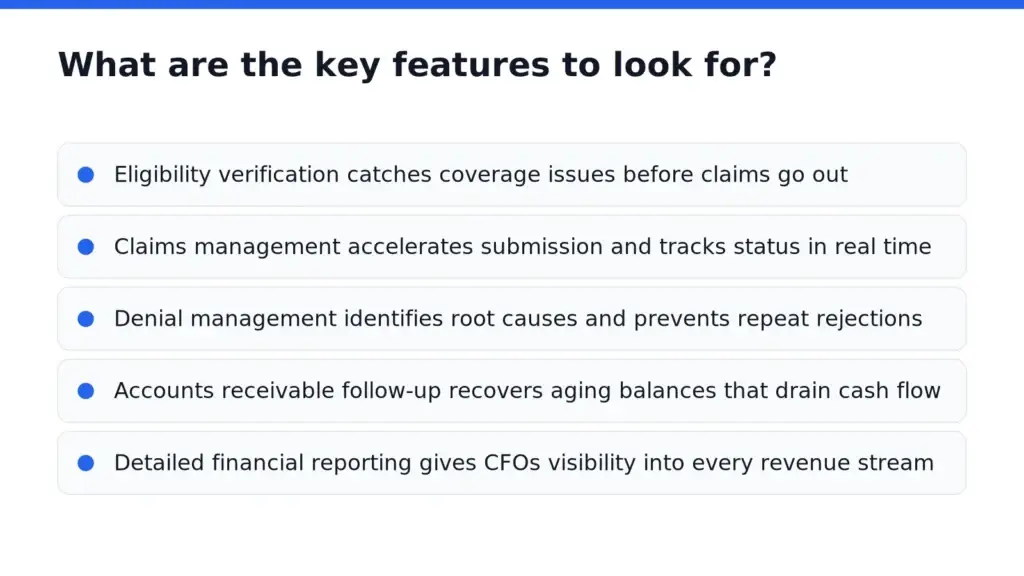
What are the key features to look for?
Selecting Hospital Revenue Cycle Management Software demands scrutiny of features that directly accelerate reimbursement and reduce revenue leakage. A platform missing core components creates gaps that cost hospitals thousands in unrecovered claims every month. The right system integrates the entire financial workflow into a single, transparent operation.
What functionality should a unified RCM platform include?
A unified platform combines eligibility verification, claims management, patient communications, and analytics. DoctorConnect’s 2026 analysis of top RCM solutions emphasizes that the best software goes beyond basic billing by integrating these four functions into one seamless system. Fragmented tools force staff to toggle between screens, introducing errors that delay payments.
How do complementary services strengthen the core platform?
Technology alone does not capture every dollar. PracticeForces supplements its end-to-end medical billing and collections with coding, denial management, accounts receivable follow-up, and detailed financial reporting. These services close the loop between claim submission and final payment. Hospitals also benefit from credentialing services, practice management consulting, EHR/PM installation and IT support, and MIPS reporting assistance. Each offering removes a distinct administrative burden from in-house teams.
Eligibility verification catches coverage issues before claims go out
Claims management accelerates submission and tracks status in real time
Denial management identifies root causes and prevents repeat rejections
Accounts receivable follow-up recovers aging balances that drain cash flow
Detailed financial reporting gives CFOs visibility into every revenue stream
What role does denial management play in revenue protection?
Denial management serves as the financial safety net for hospital billing operations. Without systematic denial workflows, rejected claims sit unresolved for weeks. PracticeForces builds denial management directly into its service model, pairing certified coders with targeted follow-up protocols. The result is faster resolution and fewer write-offs. Hospitals that neglect this feature watch otherwise collectible revenue expire.

How do you choose the right software for your hospital?
Hospital revenue cycle leaders select hospital revenue cycle management software by matching operational gaps against measurable performance commitments. Regulatory scrutiny and rising patient expectations have made manual processes and loosely connected systems untenable for clinics. The right platform closes those gaps without forcing a wholesale replacement of existing infrastructure.
What evaluation criteria matter most for hospital RCM software?
Three factors separate durable solutions from short-term fixes:
Integration depth: The software must work within the hospital’s current EHR and practice management systems rather than demanding proprietary replacements.
Specialty alignment: Teams structured around specific clinical specialties produce fewer coding errors and faster claim resolution.
Transparent pricing: Volume-based fee structures let financial leaders forecast revenue cycle costs without hidden administrative fees.
PracticeForces addresses these criteria through a model that serves independent practices, multi-site groups, and outpatient facilities across many specialties. The company’s approach pairs a U.S. front office with certified coding teams, creating continuity without inflating overhead.
How does specialty coverage affect software selection?
Hospitals managing cardiology, anesthesia, neurology, and wound care under one roof need billing logic that respects each specialty’s coding rules. Generic platforms often fail here. PracticeForces deploys specialty-aligned teams that understand the documentation and denial patterns unique to each service line. That alignment reduces first-pass rejections and accelerates reimbursement velocity.
The company also commits to transparent, volume-based pricing. Financial leaders gain predictable cost structures tied to actual claim volume rather than flat retainers. This pricing model supports long-term partnership goals focused on measurable financial outcomes, not vendor lock-in.
What are the costs and trade-offs of RCM software?
Hospital revenue cycle management software costs extend far beyond a license fee. The real expense lives in implementation delays, training disruptions, and the revenue leakage that continues while staff adapt to unfamiliar workflows. A hospital revenue cycle management software platform that demands months of integration often burns through its projected savings before producing a single clean claim. PracticeForces sidesteps this trap by working inside a facility’s existing infrastructure, adding targeted upgrades only when a clear benefit exists.
What pricing models do RCM vendors typically use?
Most vendors charge a percentage of monthly collections, creating a direct link between the vendor’s performance and the practice’s revenue. PracticeForces structures its billing services with transparent, volume-based pricing tied to monthly collections. Fixed subscription fees and per-claim charges also appear in the market, though percentage-based models align incentives most tightly.
How does staffing structure affect total cost?
Labor arbitrage drives a significant portion of RCM economics. PracticeForces pairs a U.S.-based front office with a secure India-based back office staffed by certified coders. This dual-shore model delivers scale and cost efficiency without sacrificing continuity. A fully domestic team typically costs more, while an offshore-only arrangement risks communication gaps that slow denial resolution.
The trade-off that matters most is time. Practices that delay optimization leave money unrecovered every billing cycle. Clients partnering with PracticeForces experience a 15 to 40 percent increase in revenue during the first 90 days. That acceleration compounds. A lower upfront rate means little if the vendor cannot clear the accounts receivable backlog or reduce first-pass rejections below the industry average. Revenue velocity, not just the fee percentage, determines the true cost of any RCM decision.
Why choose PracticeForces for your hospital's RCM?
PracticeForces has delivered medical billing management services to U.S. medical practices and hospitals for over two decades. The company pairs two decades of operational experience with measurable performance standards that hospital financial leaders can audit directly.
Hospitals that outsource revenue cycle functions without clear benchmarks absorb hidden losses. Denied claims age silently. Coding errors compound across thousands of encounters. PracticeForces counters this drift with published targets: less than 5% first-pass rejection rates, 12 to 24 hour claim submission cycles, and coding accuracy above 98%.
What measurable outcomes does PracticeForces commit to?
The company’s performance commitments address the three failure points that erode hospital cash flow:
First-pass rejection rate below 5% reduces rework cycles and accelerates reimbursement
Claim submission within 12 to 24 hours prevents aging receivables from stalling revenue
Coding accuracy above 98% minimizes compliance exposure and payer clawbacks
These figures function as operational service levels, not marketing language. A hospital revenue cycle director can hold the billing partner accountable against each metric monthly.
How does PracticeForces structure its hospital billing operations?
PracticeForces operates from Clearwater, Florida, as a women-owned business emphasizing responsive support and local engagement. A U.S. front-office team coordinates directly with hospital staff while a secure, certified back-office handles high-volume claims work. This structure keeps communication local while scaling processing capacity without adding hospital headcount.
For hospital CFOs evaluating hospital revenue cycle management software and outsourced billing partners, the decision turns on verifiable throughput. PracticeForces grounds its pitch in numbers that a finance team can track from the first month of engagement.
FAQ
How does hospital revenue cycle management software reduce claim rejections?
Automated claim scrubbing catches coding errors before submission, reducing first-pass rejection rates below 5% and preventing denials that would sit in accounts receivable for weeks.
What revenue gains do PracticeForces clients typically see?
PracticeForces clients experience a 15-40% revenue increase within 90 days through streamlined workflows and coding accuracy above 98%.
Does PracticeForces require hospitals to replace their existing software?
PracticeForces works within a practice’s existing infrastructure and provides targeted upgrades only when beneficial, avoiding bundled proprietary software.
Conclusion
For hospital financial leaders, the path to efficiency runs through measurable performance, not software features alone. The decision comes down to selecting a partner that commits to transparent pricing, specialty-aligned expertise, and service levels a finance team can audit monthly. By holding a billing partner accountable to rejection rates, submission cycles, and coding accuracy, hospitals convert revenue cycle management from a cost center into a predictable driver of cash flow. The next step is evaluating current performance against those benchmarks and closing the gap.