





Disputing a hospital bill starts with requesting an itemized statement listing every billing code. Approximately 80% of medical bills contain errors, so patients should check for duplicate or incorrect charges. Without a written agreement, patients hold no legal obligation to pay disputed amounts.
Key Takeaways
Requesting an itemized statement with every billing code exposes duplicate charges and services never received.
Approximately 80% of medical bills contain errors, often duplicate or incorrect charges that drain household finances.
Without a signed written agreement, patients hold no legal obligation to pay disputed amounts.
Why do hospital bills contain errors?
Hospital bills contain errors because medical billing involves complex coding systems, multiple providers, and fragmented documentation. The Patient Advocate Foundation reports that 80% of medical bills contain an error, often duplicate or incorrect charges. These mistakes drain household finances and delay legitimate reimbursement for providers.
What makes hospital billing so prone to mistakes?
The sheer volume of separate bills creates confusion. A single hospital visit generates charges from the facility, the emergency department, the radiologist, the admitting physician, and the anesthesiologist. Each entity submits its own claim. One coding slip in any of those submissions triggers a cascade of billing inaccuracies that patients must untangle.
Why does the first bill hide the real charges?
The initial statement from a provider often shows only a single total. No line items. No procedure codes. No unit counts. Patients cannot verify what they actually received against what they are being asked to pay. Without an itemized breakdown, duplicate charges and services never performed remain invisible. Requesting that itemized bill is the first concrete step in any hospital bill dispute process.
PracticeForces addresses these root causes on the provider side. The company helps healthcare organizations streamline billing operations and improve cash flow through disciplined coding, Hospital Revenue Cycle Management With Collection Partners, and Hospital Revenue Cycle Management Software Boosts Efficiency. Clean claims reduce the error rate that frustrates patients and delays practice revenue.
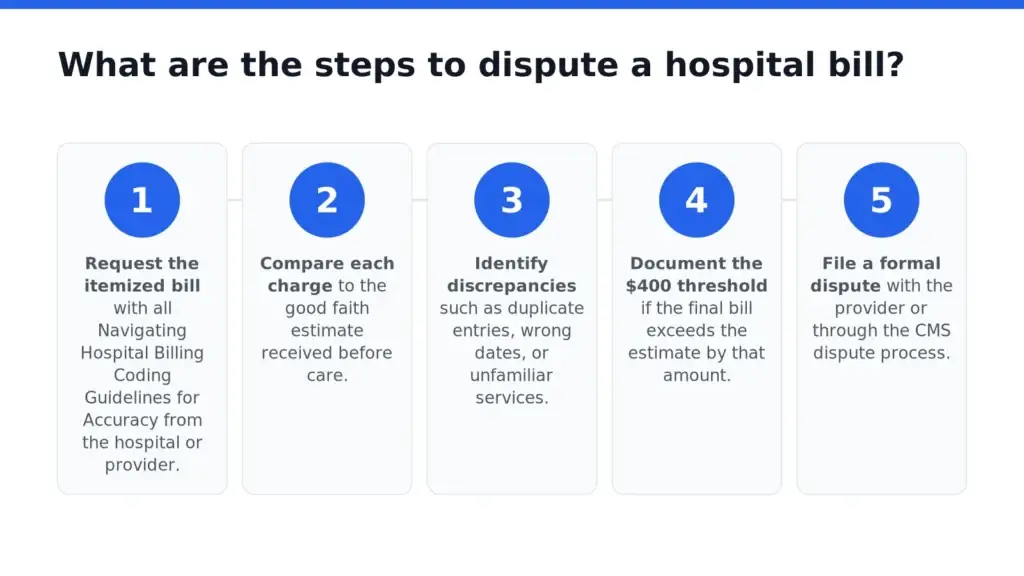
What are the steps to dispute a hospital bill?
A hospital bill dispute process starts with obtaining the full itemized statement. Patients should request every billing code listed, not just the summary total. This single document exposes duplicate charges, incorrect procedure codes, and services never received.
The No Surprises Act, effective January 1, 2022, protects patients from unexpected out-of-network bills for emergency care and certain non-emergency services. Patients who received a good faith estimate before treatment hold additional leverage. A dispute qualifies when the final bill exceeds that estimate by at least $400, according to CMS.
What should patients check first on an itemized bill?
Review each line item against personal records of the visit. Look for duplicate charges, services not performed, and incorrect dates. Compare every code to the explanation of benefits from the insurer. Coding errors drive most billing discrepancies.
Follow these steps in order:
Request the itemized bill with all Navigating Hospital Billing Coding Guidelines for Accuracy from the hospital or provider.
Compare each charge to the good faith estimate received before care.
Identify discrepancies such as duplicate entries, wrong dates, or unfamiliar services.
Document the $400 threshold if the final bill exceeds the estimate by that amount.
File a formal dispute with the provider or through the CMS dispute process.
How does the No Surprises Act affect a dispute?
The federal law limits balance billing for out-of-network emergency services. Patients receiving care at in-network facilities also gain protection from surprise charges. These protections apply to most health insurance plans.
PracticeForces maintains first-pass rejection rates below 5% and coding accuracy above 98%. That precision matters when patients challenge hospital charges. Accurate coding reduces the errors that trigger disputes in the first place.
How can you negotiate or get help with a disputed bill?
A 2024 survey of North Carolina residents found that 78 percent of people who disputed an incorrect medical bill resolved the issue in their favor. That success rate makes negotiation a rational step, not a long shot. Patients who skip the Hospital Bill Dispute Process leave money on the table and risk paying for services they never received.
What is the first thing to ask for when negotiating?
The most powerful tool is the written contract. Without a signed agreement, the patient has no legal obligation to pay an unfair bill. Debt collectors often press for payment without producing this document. A direct request for the contractual obligation shifts the burden back to the provider.
Can a billing company assist with the negotiation?
Yes. PracticeForces provides denial management and accounts receivable follow-up services that help resolve billing issues efficiently. The company couples a U.S. front-office with a secure India-based back-office staffed by certified coders. This dual-structure model enables scaled, cost-effective support for the negotiation process. Practices that outsource or co-source revenue cycle tasks gain dedicated teams who understand payer rules and denial codes. That expertise turns a slow, frustrating back-and-forth into a systematic recovery effort. Most patients lack the time and coding knowledge to sustain a prolonged dispute on their own.
FAQ
What is the first step to dispute a hospital bill?
Request an itemized statement listing every billing code. The initial bill often shows only a single total, hiding duplicate charges and services never received.
How common are errors on hospital bills?
Approximately 80% of medical bills contain errors, often duplicate or incorrect charges.
What legal protection exists for disputed amounts?
The No Surprises Act also protects against unexpected out-of-network bills for emergency care.
Conclusion
Disputing a hospital bill does not require a legal degree, only a systematic approach: request the itemized statement, compare each charge against personal records and the good faith estimate, and demand the written contract if the provider cannot justify the amount. Patients who follow these steps consistently resolve errors in their favor, turning a confusing process into a straightforward financial recovery.
Patients who want hands-on help with a dispute can call PracticeForces directly to speak with a billing specialist about their situation.