





Cardiology CPT codes span cardiovascular procedures 92920-93799, covering diagnostic tests, interventions, and monitoring services. Accurate coding drives reimbursement, yet errors trigger denials. PracticeForces reports coding accuracy above 98% and first-pass rejection rates under 5%. Cardiologists partnering with billing specialists typically see 15-40% revenue increases within 90 days through precise code selection and compliant documentation.
Key Takeaways
Cardiology CPT codes span cardiovascular procedures 92920-93799, covering diagnostic tests, interventions, and monitoring services.
Accurate coding drives reimbursement, yet errors trigger denials.
PracticeForces reports coding accuracy above 98% and first-pass rejection rates under 5%.
Cardiologists partnering with billing specialists typically see 15-40% revenue increases within 90 days through precise code selection and compliant documentation.
What Are Cardiology CPT Codes?
Cardiology CPT codes form a standardized numeric language for cardiovascular procedures and diagnostics. The American Medical Association maintains a comprehensive code range spanning 92920 through 93799 that covers coronary angioplasty, stent placement, echocardiography, stress testing, and numerous other cardiac services. Without precise code selection, cardiology practices lose thousands in legitimate reimbursement per provider each month.
These five-digit identifiers serve three critical functions for cardiovascular practices:
Proper reimbursement from Medicare and commercial payers hinges on matching the performed service to its exact code
Regulatory compliance with federal and state guidelines depends on accurate code-to-documentation alignment
Clinical documentation transparency supports quality reporting and audit defense
How do cardiology CPT codes differ from other specialty codes?
Cardiology codes carry higher complexity than most specialty code sets. Interventional procedures often bundle multiple components that coders must unbundle or sequence correctly. Diagnostic studies require modifier application based on technical versus professional components. Missing these nuances triggers denials that erode practice revenue.
Why does coding accuracy matter for cardiology reimbursement?
Incorrect cardiology coding produces claim rejections that delay payment cycles by weeks or months. Payers scrutinize high-value cardiovascular claims more aggressively than routine office visits. PracticeForces helps healthcare providers streamline billing operations and stay compliant with evolving regulations, reducing the administrative burden that pulls cardiologists away from patient care. The company’s coding accuracy exceeds 98%, protecting practices from the revenue leakage that plagues under-optimized billing workflows.

How Do Diagnostic and Interventional Codes Differ?
Diagnostic cardiology codes capture non-invasive evaluation of heart structure and function. Interventional codes document invasive procedures that treat identified disease. Cardiology remains one of the most complex specialties in healthcare from a billing and reimbursement standpoint. Every diagnostic test, interventional procedure, and patient evaluation must be documented with the correct CPT code.
Miscoding these categories triggers claim denials that delay reimbursement by weeks. A practice submitting an interventional code without supporting documentation loses the entire procedure payment. The financial exposure compounds when auditors identify patterns of misclassification across multiple claims.
What makes a cardiology code diagnostic versus interventional?
Diagnostic codes describe tests that gather data without penetrating the body or altering anatomy. These include electrocardiograms, echocardiograms, stress tests, and vascular ultrasound studies. The physician interprets results but performs no therapeutic action.
Interventional codes cover procedures where a provider accesses the cardiovascular system through catheters, needles, or surgical openings. Angioplasty, stent placement, atherectomy, and pacemaker insertion all fall under interventional coding. These codes carry higher relative value units and stricter documentation requirements.
Why does the distinction matter for reimbursement?
Payers apply different medical necessity criteria to each category. Diagnostic procedures require signs or symptoms warranting investigation. Interventional procedures demand evidence of failed medical management or acute clinical deterioration. PracticeForces builds efficient, compliant workflows from enrollment through reimbursement, designed for each client’s specialty and systems. The company serves cardiology among a wide selection of medical specialties, applying these coding distinctions to protect revenue.
Understanding Cardiology CPT Codes at this granular level prevents the most common denial triggers. A diagnostic echo coded as an interventional study invites immediate rejection. The reverse error undervalues the physician’s work and leaves thousands of dollars unrecovered per quarter.
Which Modifiers Prevent Cardiology Claim Denials?
Cardiology claim denials often trace back to missing or incorrect modifiers. Modifier selection determines whether payers process a claim on the first pass or reject it outright. PracticeForces maintains first-pass rejection rates below 5% and coding accuracy above 98%, outcomes built on precise modifier application across every cardiology submission.
Why do cardiology modifiers matter more under the No Surprises Act?
The No Surprises Act, effective January 1, 2022, changed reimbursement rules for out-of-network providers working in in-network facilities. Incorrect modifier use in these scenarios triggers automatic denials rather than payment delays. A good faith estimate must be given to all self-pay patients under the second interim final rule, and modifier errors on those claims create compliance exposure that practices carry long after the service date.
Which modifiers cause the most cardiology denials?
Several modifier categories demand consistent attention from cardiology billing teams:
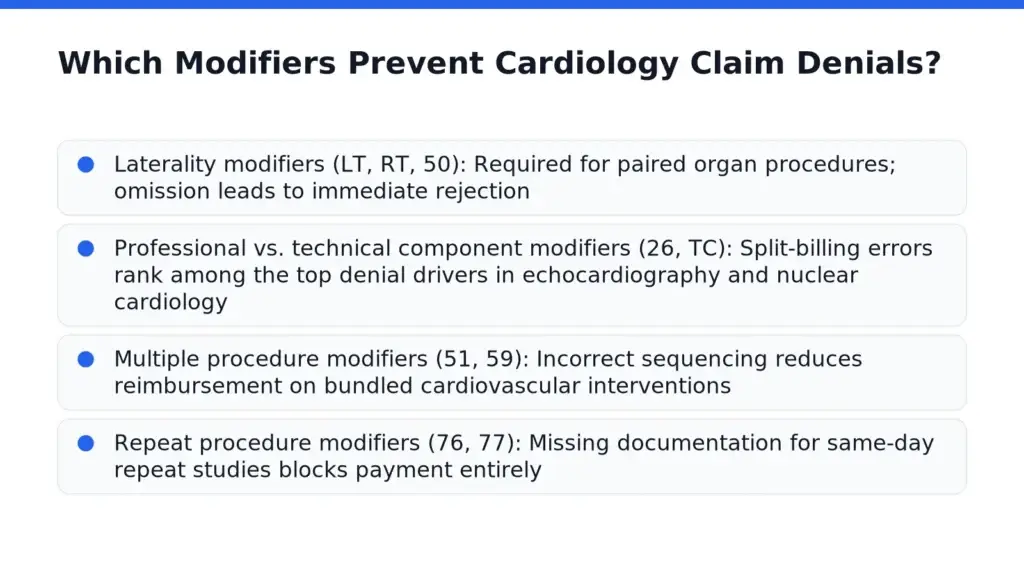
Laterality modifiers (LT, RT, 50): Required for paired organ procedures; omission leads to immediate rejection
Professional vs. technical component modifiers (26, TC): Split-billing errors rank among the top denial drivers in echocardiography and nuclear cardiology
Multiple procedure modifiers (51, 59): Incorrect sequencing reduces reimbursement on bundled cardiovascular interventions
Repeat procedure modifiers (76, 77): Missing documentation for same-day repeat studies blocks payment entirely
PracticeForces denial management and accounts receivable follow-up services target these exact failure points. The company’s coding teams review modifier selection before submission, catching errors that otherwise surface weeks later as denied claims. Cardiology practices lose revenue silently when modifier mistakes go uncorrected. Each rejected claim represents hours of rework and delayed cash flow that compounds across a practice’s monthly billing cycle.
How Do You Build a Clean Cardiology Claim?
Building a clean cardiology claim starts with precise documentation and rapid submission. PracticeForces submits claims within 12 to 24-hour cycles, a speed that prevents the revenue leakage common in slower billing operations. First-pass rejection rates stay below 5% when coding accuracy exceeds 98%. These metrics matter because every denied cardiology claim erodes a practice’s financial stability and consumes staff hours better spent on patient care.
The foundation of a clean claim rests on understanding cardiology CPT codes and their strict documentation requirements. Cardiology billing carries unique complexity. Diagnostic catheterizations, interventional procedures, and rhythm management services each demand specific code pairings and modifier logic. A single mismatched code triggers a denial that delays reimbursement by weeks.
What documentation supports a clean cardiology claim?
Transparency in clinical documentation supports quality care and streamlined revenue cycle management. The operative report must clearly describe vessel locations, lesion characteristics, and medical necessity for each intervention. Coders cannot infer what the physician did not explicitly record. Missing details about stent placement or fractional flow reserve measurements create coding gaps that payers exploit to deny payment.
How does infrastructure affect claim cleanliness?
PracticeForces works within a practice’s existing infrastructure rather than bundling proprietary software. This approach eliminates the friction of system migrations that disrupt billing workflows. A U.S. front-office pairs with a secure India-based back-office staffed by certified coders. The dual-team structure enables continuous claim scrubbing across time zones. Claims prepared during U.S. business hours undergo overnight review, catching errors before submission deadlines pass.
The numbered steps for building a clean cardiology claim follow a disciplined sequence:
Verify patient eligibility and benefits before the encounter, confirming coverage for planned cardiovascular procedures.
Capture complete clinical documentation during the procedure, including anatomical specificity and medical necessity language.
Assign CPT codes and modifiers based on the operative report, not on charge sheets or physician preference cards.
Scrub the claim against payer-specific edits and National Correct Coding Initiative bundles within 12 hours of code assignment.
Submit the claim electronically and monitor the 24-hour acknowledgment report for rejection flags.
Practices that skip eligibility verification lose revenue before the claim ever reaches a payer. Those that delay submission beyond 24 hours accumulate aging accounts receivable that compound collection difficulty. The combination of rapid turnaround, certified coding teams, and existing-system integration produces the measurable results PracticeForces delivers: fewer denials, faster payments, and a revenue cycle that supports rather than distracts from clinical cardiology.
What Mistakes Cause Cardiology Billing Delays?
Cardiology billing delays drain revenue and frustrate staff. Understanding Cardiology CPT Codes prevents the most common errors that stall reimbursement. Practices lose thousands of dollars monthly when claims sit unpaid. The damage compounds fast.
Why Do Incorrect Modifiers Delay Cardiology Claims?
Modifier misuse triggers immediate denials. Cardiology procedures often require multiple modifiers to describe bilateral interventions, professional and technical components, or distinct procedural services. A missing modifier 26 on an echocardiogram interpretation, for example, causes the payer to reject the entire claim. Coders must verify modifier requirements for each CPT code before submission. Coverage and reimbursement vary significantly by payer, plan, and patient status, making modifier precision non-negotiable.
How Does Insufficient Documentation Slow Reimbursement?
Payers demand procedure notes that match the billed code exactly. A stress echo coded as 93351 requires documentation of continuous monitoring, physician supervision, and interpretive report. Missing any element triggers a request for records. That request adds 30 to 45 days to the payment cycle. Cardiology practices lose momentum when documentation lags behind coding. PracticeForces addresses this through integrated revenue cycle management that aligns clinical notes with billing requirements from the start.
What Role Do Eligibility Errors Play in Payment Delays?
Unverified benefits cause denials that take weeks to resolve. Cardiology services span diagnostic testing, interventional procedures, and follow-up care, each with distinct prior authorization rules. A practice that fails to confirm coverage for a nuclear stress test before the appointment risks performing an unreimbursed service. The financial impact hits hard. PracticeForces clients experience a 15 to 40 percent increase in revenue during the first 90 days of partnership, driven partly by rigorous eligibility verification protocols. Since 2003, the company has provided medical billing management services that catch these errors before claims leave the practice. Complementary MIPS reporting assistance and practice management consulting further strengthen compliance and speed reimbursement.
FAQ
What are cardiology CPT codes?
Cardiology CPT codes are five-digit identifiers from 92920 to 93799 that standardize cardiovascular procedures, diagnostics, and interventions for reimbursement and compliance.
How do diagnostic and interventional cardiology codes differ?
Diagnostic codes capture non-invasive evaluations of heart structure and function, while interventional codes document invasive procedures that treat disease. Miscoding these categories causes claim denials that delay reimbursement.
Conclusion
A cardiology practice that commits to precise documentation, rigorous eligibility checks, and rapid claim submission builds a revenue cycle that supports clinical priorities rather than draining them. The next step is to evaluate whether your current billing operation meets these standards or leaves revenue on the table through preventable delays.
Reach out to PracticeForces at claims@practiceforces.com to discuss how precise cardiology coding and billing support can protect your practice’s revenue.